
The FIFA World Cup draw is the moment a sprawling list of 48 qualified nations turns into a real tournament bracket, and the 2026 edition set the shape of the whole event. The draw took place on 5 December 2025 in Washington D.C., sorting teams into 12 groups of four, with the final gaps filled after the play-offs ended on 31 March 2026. Once the groups were locked, every fixture, every travel plan and every early betting market followed from them. This guide explains how the draw itself worked, how the seeding pots were built, where the three host nations were placed, and how the group stage decides who moves on. For the wider picture, our World Cup 2026 complete guide ties all of it together.
Quick answer
The FIFA World Cup draw sorted 48 teams into 12 groups of four using four seeding pots based largely on the FIFA ranking, with the three hosts placed by design. In the group stage, every team plays the other three once. A win is three points, a draw one, a loss none. The top two in each group, plus the eight best third-placed teams, advance to the round of 32.
How the World Cup draw works
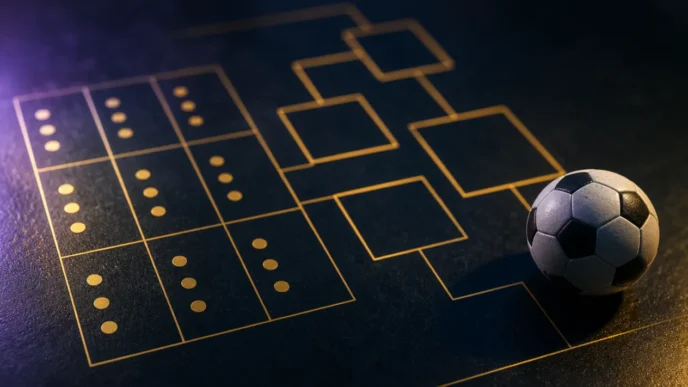
The draw is essentially a controlled sorting exercise. With 48 teams confirmed, FIFA split them into four pots of 12. Pot 1 held the three host nations and the highest-ranked qualifiers. Pots 2, 3 and 4 followed in descending order of the FIFA world ranking, so the strongest sides on paper sat in Pot 1 and the lowest-ranked qualifiers landed in Pot 4. Teams that came through the late play-offs in March 2026 filled the remaining Pot 4 places once their results were known.
From there, balls were drawn one pot at a time, starting with Pot 1, and each team was assigned to a group from A to L. The aim was simple: spread the strength evenly, so no group ended up stacked with four heavyweights while another looked thin. Each group of four took one team from each pot, which is why every group contained a Pot 1 seed, a Pot 2 side, and so on.
The mechanics line up with the wider tournament format, which moved to 48 teams and 12 groups for the first time. More groups meant more seeded positions to fill, but the underlying idea stayed the same as previous editions.
The seeding pots at a glance
The table below shows how the four pots were structured. The exact membership depended on the FIFA ranking at the time of the draw and on the play-off results, so this is the framework rather than a team list.
| Pot | Who went in | Rough strength |
|---|---|---|
| Pot 1 | Three hosts plus the top-ranked qualifiers | Highest seeds |
| Pot 2 | Next group by FIFA ranking | Strong |
| Pot 3 | Following group by FIFA ranking | Mid |
| Pot 4 | Lowest-ranked qualifiers and play-off winners | Lowest seeds |
This is why a Pot 1 seed and a Pot 4 side could meet in the group stage but two Pot 1 teams could not. The structure guaranteed a spread of seeding across all 12 groups.
Why host placement mattered
With three host countries, FIFA could not leave their positions to chance. The United States, Canada and Mexico were all placed in Pot 1 and assigned to predetermined group slots before the rest of the draw filled in around them. That kept the hosts in separate groups and helped manage the geography, since teams in a given group play their matches in clusters of host cities rather than criss-crossing a continent.
Mexico opened the tournament at Estadio Azteca in Mexico City on 11 June 2026, which was fixed in advance as part of the host arrangement. Anchoring the hosts to set positions is standard practice, and with 16 host cities spread across three nations it carried more weight than usual. Our rundown of the stadiums and host cities shows how those venues cluster by region, which is part of why grouping geography matters. It is one reason the draw is choreographed rather than a pure lottery.
Confederation rules also shaped the draw. As a general principle, no group could contain two teams from the same confederation, with the single exception of UEFA. Europe sent so many qualifiers that some groups had to include two European sides. Every other confederation was kept to one team per group, which avoided, for example, two South American or two African teams landing together at the group stage.
How the group stage works
Once the 12 groups were set, the group stage followed a straightforward round-robin. Each team plays the other three in its group once, so every side gets three group matches. Points are awarded the standard way:
- A win is worth three points
- A draw is worth one point
- A loss is worth zero points
Teams are ranked within their group by total points after three matches. The two teams at the top of each group advance automatically. Because there are 12 groups, that produces 24 qualifiers straight away. The expanded format then adds a wrinkle that older tournaments did not have, which is where the best third-placed teams come in.
Top two plus the best third-placed teams
Twenty-four teams from the top two of each group is not enough to fill a round of 32, which needs 32. The gap is closed by the eight best third-placed teams across all 12 groups. So after the group stage, FIFA ranks every third-placed side against the others, and the top eight of those join the 24 group winners and runners-up in the knockouts.
That single rule changes how the group stage feels. A team can finish third and still go through, which keeps more nations alive deeper into the final round of group games. It also means a third-placed side is not only watching its own group, but tracking results elsewhere to see whether its points total holds up against third-placed teams in other groups.
| Finishing position | Outcome |
|---|---|
| 1st in group | Advances to round of 32 |
| 2nd in group | Advances to round of 32 |
| 3rd in group | Advances only if among the eight best third-placed teams |
| 4th in group | Eliminated |
How tie-breakers are settled
When two or more teams finish level on points, the draw and the group rules need a way to separate them. FIFA applies its tie-breakers in a set order. The first checks are based on the matches across the whole group:
- Goal difference across all group matches
- Goals scored across all group matches
If teams are still level after that, the comparison narrows to the games between the tied teams only: points won in those head-to-head matches, then goal difference in them, then goals scored in them. If everything is still equal, fair-play conduct (yellow and red cards) is used, and a drawing of lots is the final resort.
Here is a worked example. Imagine three teams in a group all finish on six points. Team A has a goal difference of plus four, Team B plus two, and Team C plus one. On the first tie-breaker, Team A takes top spot and Team B edges Team C, so Team C drops to third. Team C is not out yet, because it can still qualify as one of the eight best third-placed teams, but only if its record holds up against the other groups.
A simple group-stage example
Say a group runs as follows after all six matches. The exact teams are not the point here, only how the points and order work.
| Team | Played | Won | Drawn | Lost | GD | Points |
|---|---|---|---|---|---|---|
| Team 1 | 3 | 2 | 1 | 0 | +4 | 7 |
| Team 2 | 3 | 1 | 2 | 0 | +1 | 5 |
| Team 3 | 3 | 1 | 1 | 1 | 0 | 4 |
| Team 4 | 3 | 0 | 0 | 3 | -5 | 0 |
Team 1 and Team 2 advance as the top two. Team 4 is out. Team 3 finishes third on four points and goes into the pool of third-placed teams, where four points may or may not be enough to make the best eight, depending on how the other 11 groups shook out. This is the part of the 2026 format that rewards staying competitive even in a group you are unlikely to win.
If you want to see how these stages fit the calendar, the schedule and key dates page lays out when the group games and knockouts were played, from the 11 June opener to the final on 19 July at MetLife Stadium.
What the draw means for betting
For anyone following the markets, the draw is the first real pricing event of a World Cup cycle. It is also when outright and group prices at sites like Campeonbet start to settle into something meaningful. If you are new to it, our guide to betting on the World Cup walks through how these markets are built. Until the groups are known, outright odds rest on general strength. Once teams are sorted, bookmakers can see who got a kind route and who landed in a tough group, and prices move accordingly. A title favourite drawn into a soft group might shorten slightly, while a fancied side stuck with two strong opponents could drift. That shift in route is exactly what feeds the winner predictions once the groups are locked.
In the early-June 2026 markets, Spain sat around 5.75 and France near 6.00 at the front, with England, Brazil and defending champions Argentina close behind (odds as of June 2026, and they vary by bookmaker and move daily). Reading those prices is easier once you know how betting odds reflect probability. Once the groups were locked, a seed’s path to the round of 32 depended on exactly who shared its group. That is why the World Cup group winner markets at Campeonbet leaned so heavily on the draw.
The range of World Cup betting markets goes well beyond outrights, from group winners to to-qualify bets that hinge on the draw. None of that is a sure thing. The draw shapes the odds, but it does not decide the football.
Frequently asked questions
When did the FIFA World Cup 2026 draw take place? The Final Draw was held on 5 December 2025 in Washington D.C. The groups were completed after the play-offs finished on 31 March 2026, once the last qualifiers were confirmed and slotted into their pots.
How many teams qualify from each group? The top two from each of the 12 groups qualify directly, which is 24 teams. The eight best third-placed teams across all groups also go through, filling out a round of 32.
How are the seeding pots decided? Pots are built mainly on the FIFA world ranking, with the three host nations placed in Pot 1 by design. The highest-ranked teams sit in Pot 1 and the lowest-ranked qualifiers in Pot 4, with one team from each pot in every group.
Can two teams from the same country’s confederation be in one group? As a rule, no, with one exception. UEFA had so many qualified teams that some groups contained two European sides. Every other confederation was limited to one team per group.
What happens if teams finish level on points? FIFA uses a fixed order of tie-breakers: goal difference, then goals scored, then head-to-head results among the level teams, then fair-play points, and finally a drawing of lots if nothing else separates them.
Conclusion
The draw turned 48 qualifiers into 12 balanced groups, using four seeding pots and fixed host positions to keep things even and geographically sensible. From there the group stage is simple to follow: three round-robin games each, three points for a win, and the top two plus the eight best third-placed teams moving into the round of 32. Get those rules straight and the rest of the tournament reads clearly. For the full overview of dates, venues and format, head to our complete World Cup 2026 guide.

BetWise specialises in sports betting guides, betting strategies, odds, and betting market analysis. Through educational content and practical insights, BetWise helps readers build their understanding of sports betting and major sporting events.